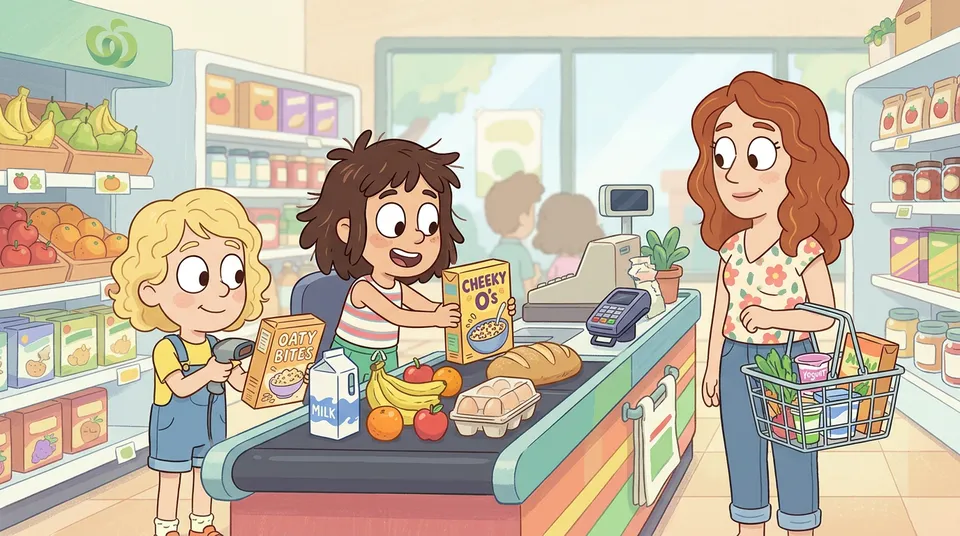
The supermarket is the shop children know best. They’ve walked the aisles, watched items get scanned, and seen the total climb on the register. Now they get to be the one behind the counter.
In myplayshop’s supermarket, your child runs the checkout. Customers arrive with baskets of everyday products. Your child scans each item, totals the order, takes payment, and gives change.
Why the Supermarket Is a Step Up
The supermarket is myplayshop’s big challenge — and children love rising to it:
- Bigger baskets — Customers buy more items, meaning longer addition chains
- Higher totals — Orders regularly reach $15–$30, pushing children into two-digit mental maths
- Real-world connection — Every child has been to a supermarket. The setting is instantly meaningful
A Typical Checkout
A customer loads the belt:
- Milk: $3.50
- Bread: $2.00
- Cheese: $4.50
- Cereal: $3.75
- Apples: $2.25
- Total: $16.00
- Customer pays with: $20.00
- Change needed: $4.00
Five items to scan and add. A total that requires carrying. Change from a $20 note. This is proper maths practice.
Developing Advanced Money Skills
The supermarket pushes children beyond basics:
Long addition chains. Adding five or six prices together builds working memory. Children learn to hold running totals in their head — a skill that transfers far beyond shopping.
Larger denominations. When totals hit $20 or $30, customers pay with bigger notes. Giving change from $50 is a real mental workout.
Price awareness. Children start to develop a sense of what things cost. “Milk is about $3, bread is about $2” — this intuition helps them spot mistakes and estimate totals.
The Right Time for the Supermarket
- Ages 5–6 — Start with small baskets of two or three items. Build comfort with the scanning and payment flow
- Ages 6–8 — Full baskets of four to five items. Adding totals and giving change from $10 or $20
- Ages 8–10 — Large orders handled quickly. Giving change from $50, estimating totals before scanning, and checking their own work
Why It Matters
The supermarket is where money maths meets daily life. Every skill your child practises here — adding prices, handling notes, calculating change — is something they’ll use for real. The child who can confidently handle a $25 grocery order in myplayshop can handle one in real life too.
Supermarket Maths at Home
- Real checkout helper — At the supermarket, let your child estimate the total as you shop. How close can they get?
- Budget challenge — “We have $20 for dinner ingredients. Can you pick items that fit?”
- Receipt maths — After shopping, look at the receipt together. “What was the most expensive item? The cheapest? What’s the difference?”