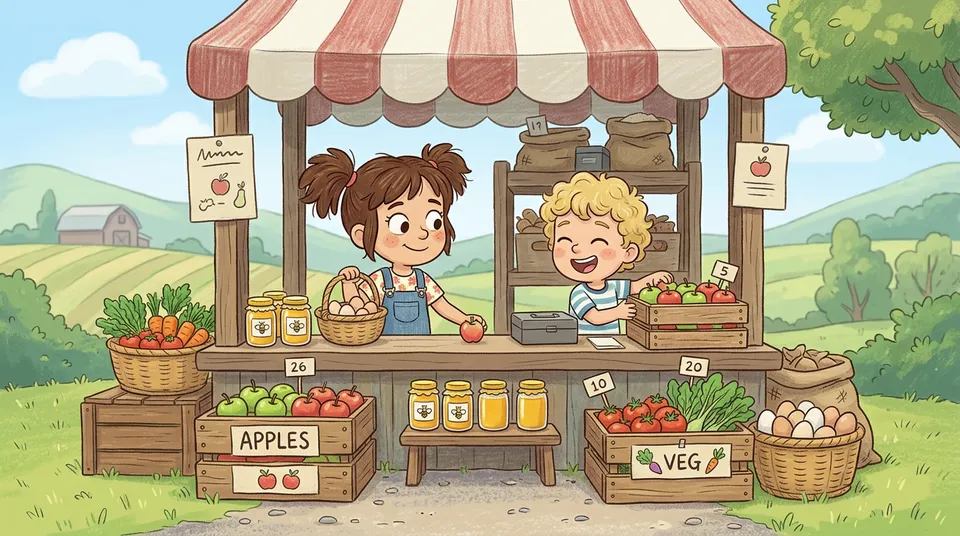
Fresh eggs, baskets of apples, jars of golden honey — the farm shop brings the countryside to your child’s screen. For nature-loving children, it’s the perfect setting to practise money skills.
In myplayshop’s farm shop, your child runs the stall. Customers arrive wanting fresh produce. Your child weighs up the order, takes payment, and gives the right change.
Why Kids Love the Farm Shop
The farm shop connects money maths to the natural world:
- Wholesome products — Fruit, vegetables, and eggs feel tangible and real. Children can picture where they come from
- Medium-range prices — Farm produce sits in a comfortable price range, neither too small nor too large
- Seasonal variety — The mix of products keeps each transaction feeling fresh
What a Typical Transaction Looks Like
A customer arrives at the stall:
- Basket of eggs: $3.00
- Bag of apples: $2.50
- Jar of honey: $4.00
- Bunch of carrots: $1.50
- Total: $11.00
- Customer pays with: $15.00
- Change needed: $4.00
Four items, a two-digit total, and straightforward change — a satisfying challenge for most ages.
Building Practical Maths Skills
The farm shop develops skills children will use every time they visit a real shop:
Everyday products. These are items children see in their own kitchen. The connection between game and reality is immediate — “We buy eggs too!”
Round-number practice. Farm produce tends to have cleaner prices ($1.50, $2.00, $3.50), which helps children build confidence with addition before tackling awkward amounts.
Moderate totals. Orders typically land between $5 and $15. This is the range where children transition from counting coins to calculating mentally.
Age-by-Age Progression
- Ages 4–6 — Selling one or two items. Matching coins to simple prices like $2.00 or $3.00
- Ages 6–8 — Three or four items per order. Adding up to $10–$15 and giving change from $20
- Ages 8–10 — Busy market day. Handling multiple customers, larger orders, and quick change calculations
Farm Shop to Kitchen Table
- Shopping together — At the supermarket, find the fruit and veg aisle. Let your child pick items and add up prices as you go
- Farmers’ market trip — Visit a real farmers’ market and let your child handle the payment
- Garden maths — “We grew 12 tomatoes. If we sell them for $0.50 each, how much would we earn?”
- Price comparison — “Eggs cost $3 at the farm shop and $4 at the supermarket. How much do we save?”