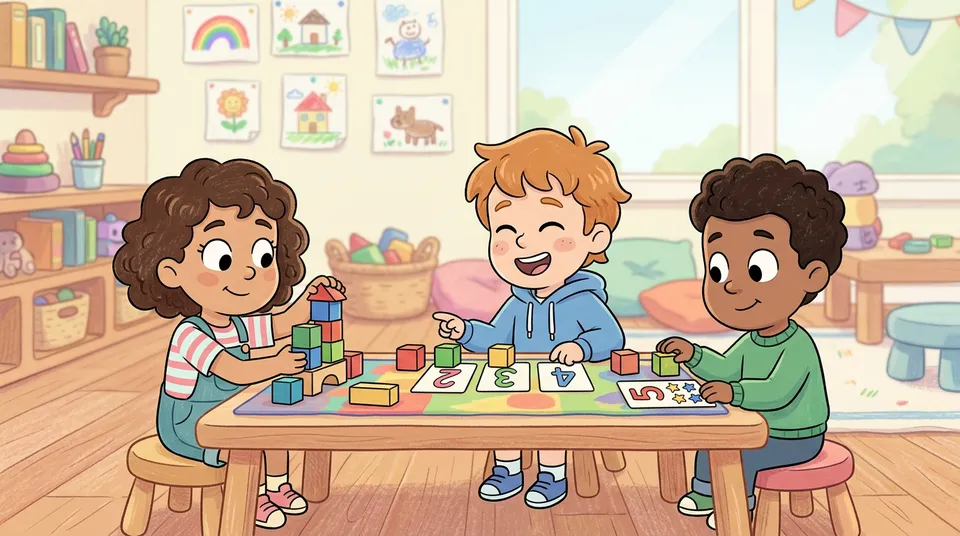
If you’ve ever watched a child reluctantly drag through a page of sums, then enthusiastically spend an hour building with blocks or playing shop, you’ve seen the core problem with traditional maths teaching. The knowledge is the same. The engagement is completely different.
Play-based learning isn’t just a feel-good idea. It’s backed by decades of research, and for maths in particular, the evidence is remarkably strong.
What Is Play-Based Learning?
Play-based learning is exactly what it sounds like: children learn through activities that feel like play rather than instruction. But there’s a crucial nuance. It’s not just “letting kids play and hoping they learn something.” Effective play-based learning involves intentionally designed activities where educational goals are embedded in genuinely enjoyable experiences.
A child playing shop and calculating change is doing play-based maths. A child completing a worksheet with pictures of shops on it is not. The difference isn’t cosmetic — it’s about who drives the experience. In play, the child is in control, making decisions, and encountering problems they’re motivated to solve.
What the Research Shows
The evidence for play-based maths learning is substantial. Here are the key findings:
Children retain more. A landmark study from the University of Cambridge found that children who learned mathematical concepts through guided play retained those concepts significantly longer than children who received direct instruction alone. The play group also showed better ability to apply what they’d learned to new situations.
It builds deeper understanding. Research published in the journal Developmental Psychology showed that children who learn through play develop conceptual understanding, not just procedural knowledge. They don’t just know that 3 + 4 = 7; they understand what addition means. This deeper grasp makes it easier to learn more complex maths later.
It reduces maths anxiety. Studies consistently show that maths anxiety starts young, sometimes as early as age six. Play-based approaches remove the pressure that causes anxiety. When there’s no right or wrong answer in the moment, children experiment freely, and that experimentation is where real learning happens.
It works across ability levels. One of the most compelling findings is that play-based learning benefits all children, not just those who are already strong at maths. Research from Stanford University found that game-based maths activities were particularly effective for children who had been struggling with traditional instruction.
Why Play Works Better Than Worksheets
Understanding the research is useful, but understanding why play works helps you apply the principle at home. Several factors make play uniquely effective for maths:
Motivation is built in
When a child is playing a game, they want to solve the problem. A shopkeeper needs to give correct change because the game depends on it. A builder needs to count blocks because their tower will fall otherwise. The maths isn’t a chore to complete — it’s a tool to achieve something the child cares about.
Worksheets reverse this. The child completes sums to satisfy an external requirement (the teacher, the parent, the homework), not because they personally need the answer. This difference in motivation affects how deeply the brain processes the information.
Mistakes feel safe
In a worksheet, a wrong answer gets marked incorrect. In a game, a wrong answer just means you try a different strategy. This distinction matters enormously for learning.
Neuroscience research shows that the brain learns most effectively when errors occur in a low-threat environment. Play naturally creates this environment. A child who gives the wrong change in a pretend shop simply recounts — there’s no judgement, no grade, and no lasting consequence. Over time, this builds confidence and a willingness to tackle harder problems.
It’s multi-sensory
Play typically involves physical objects, movement, and conversation. A child playing with coins is seeing, touching, sorting, and counting simultaneously. This multi-sensory engagement activates more areas of the brain than reading numbers on a page, which creates stronger memory connections.
This is particularly important for younger children (ages 4-7), whose abstract thinking skills are still developing. Handling physical money teaches value more effectively than seeing numbers on paper because the concept is grounded in something they can touch.
Repetition happens naturally
One of the great hidden strengths of game-based learning is that children willingly repeat activities far more than they would with worksheets. A child might happily play 20 rounds of a shop game, practising addition and subtraction each time. Ask them to do 20 sums on paper and you’ll face resistance by sum three.
This voluntary repetition means more practice, which means stronger skills, all without any battles over homework.
Play-Based Learning in Action: Maths at Home
You don’t need expensive materials or a teaching degree. Here are practical ways to bring play-based maths into your home:
Counting games with real objects
Use building blocks, LEGO bricks, dried pasta, or buttons. “Can you give me exactly 15 blocks? Now split them into two equal groups. Can you? What happens?” These simple challenges develop number sense far more effectively than number tracing.
Shop play
The classic “playing shop” is one of the most mathematically rich games a child can play. They practise counting, addition, subtraction, and money recognition all at once. Set up a shop with household items and real coins, or use myplayshop for a realistic digital version with real currency denominations.
Board games
Snakes and Ladders teaches counting and number recognition. Monopoly Junior introduces money management. Even simple dice games (“roll two dice and add them together — highest number wins”) pack in surprising amounts of practice.
Cooking together
Following a recipe involves measuring, fractions, multiplication (doubling a recipe), and time. It’s practical maths that produces something delicious. “We need half a cup of flour. This is a full cup — how do we get half?”
Building and construction
Whether it’s blocks, LEGO, or cardboard boxes, building involves spatial reasoning, measurement, estimation, and problem-solving. “How many more blocks do you need to make this side the same height as that side?”
What About Screen Time?
A common concern is whether digital games count as play-based learning. The answer: it depends on the game.
A well-designed educational app like myplayshop that puts the child in control, requires genuine calculation, and provides meaningful feedback absolutely counts. The child is making decisions, solving problems, and learning from outcomes — the same principles that make physical play effective.
A game that simply dresses up worksheets with animations and sound effects does not count. If the child is just tapping the correct answer from four options, that’s still drill-based learning with a digital skin.
The key questions to ask about any educational app:
- Does my child make meaningful decisions?
- Does the maths arise naturally from the activity?
- Would my child choose to play this even without being asked?
- Does it involve more than just selecting the right answer?
If the answer to all four is yes, it’s genuine play-based learning.
When Worksheets Do Have a Place
This isn’t an argument that worksheets are useless. For older children (8+) who already have a solid conceptual foundation, structured practice has its place. The problem arises when worksheets are the primary method of maths education, especially for younger children who haven’t yet built that conceptual understanding.
Think of it like learning a language. You wouldn’t teach a child to speak by giving them grammar worksheets. You’d immerse them in conversation, stories, and play. Once they have a natural feel for the language, formal grammar study becomes useful. Maths works the same way.
Making the Shift
If your child currently associates maths with worksheets and homework, the shift to play-based learning doesn’t happen overnight. Start small:
- Replace one worksheet session per week with a game that involves the same skills. If they’re practising addition, play a shop game instead.
- Point out maths in daily life. “We need eight plates for dinner. We have five out. How many more do we need?” This casual, in-context maths is incredibly powerful.
- Follow their interests. If your child loves cooking, do maths through recipes. If they love building, do maths through construction. The content area matters less than the engagement.
- Don’t announce it. The moment you say “we’re going to do some maths now,” you’ve lost half the magic. Just play. The learning will happen.
The Bottom Line
Children are natural mathematicians. Watch any group of four-year-olds sharing sweets and you’ll see surprisingly sophisticated division and fairness reasoning. The challenge isn’t teaching them to think mathematically — it’s not drilling that instinct out of them.
Play-based learning works because it respects how children’s brains actually develop. It provides motivation, safety, repetition, and multi-sensory engagement, the four ingredients that neuroscience tells us are essential for lasting learning.
The best maths education doesn’t feel like education at all. It feels like fun.