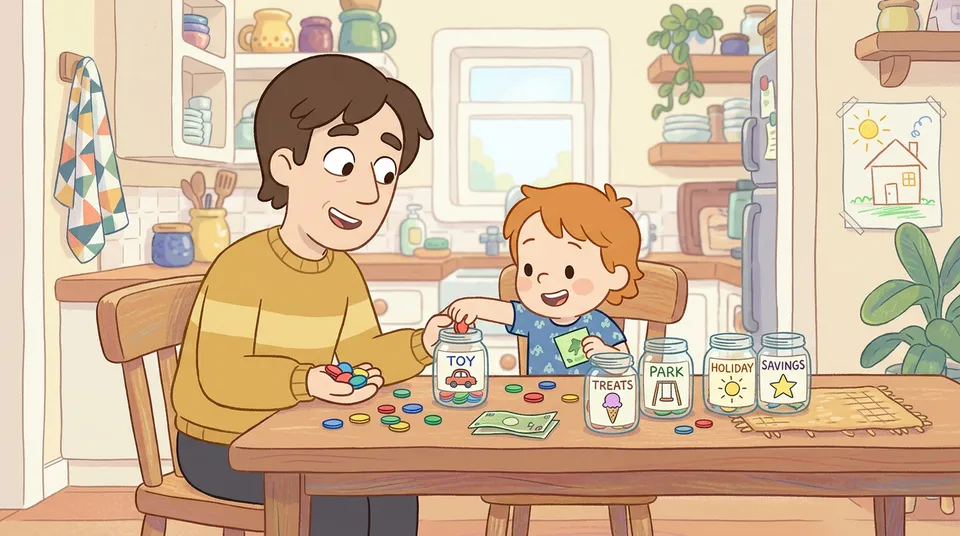
When should you start teaching your child about money? The short answer: earlier than you think. Children as young as three begin to understand the basic idea of exchange — you give something to get something — and by age seven, many of their financial habits are already forming.
That doesn’t mean you need to sit a four-year-old down with a spreadsheet. It means weaving money concepts into everyday life in ways that match what your child can actually understand at their age.
Here’s what that looks like, stage by stage.
Ages 4-5: Recognising and Naming Money
At this age, children are learning to count, recognise shapes, and sort objects into categories. Money fits perfectly into all three.
What they can grasp:
- Coins and notes are different from each other
- Different coins have different values
- You exchange money for things you want
- Shops involve giving money and receiving items
Activities that work:
- Coin sorting: Empty a jar of coins and sort them by type. Name each coin together. “This is a 50p — it’s the big one with seven sides.”
- Playing shop: Set up a pretend shop with toys or household items. Use real coins if possible, so they get used to handling money. Or try myplayshop for a ready-made shop experience with real currency.
- Spot the price: When you’re out shopping, point out price labels. “Look, that apple costs 30p. Can you find the 30 on the sign?”
- Piggy bank saving: Give your child a transparent jar (better than a piggy bank because they can see the money grow). Even saving a few coins a week teaches the concept.
Keep in mind: Don’t worry about exact values yet. At this age, many children think a physically larger coin is worth more. That’s completely normal. Focus on the idea that money exists, it has names, and we use it to buy things.
Ages 6-7: Counting, Comparing, and Simple Transactions
This is where things get exciting. Children at this stage can add and subtract small numbers, which means they’re ready for real money maths.
What they can grasp:
- Adding up the value of several coins
- The concept of “enough” — do I have enough money for this?
- Giving change (with small, simple amounts)
- Comparing prices — which costs more?
- The idea that money is earned, not unlimited
Activities that work:
- The exact change challenge: Give your child a handful of coins and a target amount. Can they make exactly 65p? How about using the fewest coins possible?
- Shop with a budget: At the supermarket, give them a £2 budget for a snack. They need to find something they want that costs less than £2 and work out the change.
- Earning pocket money: If you haven’t started pocket money, this is a great age to begin. Even a small weekly amount teaches budgeting over time. Let them decide how to spend it.
- Playing shopkeeper: Whether it’s a living-room shop or myplayshop, have your child be the one giving change. Start with round numbers (“That’s £1, and they gave you £2”) before moving to coins.
- Wants vs needs sorting: Lay out pictures of different items and sort them into “things we need” and “things we want.” It’s a simple exercise that introduces surprisingly deep financial thinking.
Keep in mind: Mistakes are important. When your child counts incorrectly, resist the urge to correct immediately. Let them recount. Self-correction builds stronger skills than being told the right answer.
Ages 8-10: Budgeting, Saving Goals, and Value
By this stage, children can handle multi-step problems and think ahead. They’re ready for concepts that go beyond single transactions.
What they can grasp:
- Saving towards a goal over several weeks
- Budgeting a fixed amount across multiple needs
- The concept of value for money (not just the cheapest option)
- How people earn money through different jobs
- Basic understanding of why things cost what they do
- Interest and the idea that saved money can grow
Activities that work:
- The savings goal chart: Help your child pick something they want to save for. Create a visual chart showing their progress each week. The act of watching savings grow — and the patience it requires — is one of the most valuable financial lessons there is.
- Weekly budget manager: Give a slightly larger allowance and make it cover more than one thing. For example, £5 for the week must cover a snack at school, a small treat, and savings. They’ll learn quickly that spending everything on day one leaves nothing for later.
- Price comparison detective: When shopping online or in a store, ask your child to compare two similar products. Which is better value? Why? This teaches them to look beyond the price tag.
- The family meal planner: Let your child plan a simple meal within a budget. They look at recipes, check prices, and work out what they can afford. It’s real-world maths with a delicious reward.
- Entrepreneurial projects: At this age, children can run a more sophisticated small business — selling handmade crafts, offering a car-washing service, or organising a neighbourhood event. The combination of pricing, costs, and profit is genuine financial education.
Keep in mind: Children at this age start to notice family financial differences. Be honest in age-appropriate ways. You don’t need to share your salary, but you can explain concepts like “we choose to spend more on food and less on other things because that’s what matters to our family.”
Common Mistakes Parents Make
Even well-intentioned money education can go sideways. Here are the most common pitfalls:
Shielding children from all money talk. Kids who never hear about family financial decisions grow up without context. You don’t need to share everything, but including them in simple choices (“Should we buy the branded cereal or save £1 with the own-brand version?”) builds awareness.
Making it too abstract. Young children need physical money they can touch, sort, and count. Digital concepts come later. Start with coins and notes before moving to apps and cards.
Turning every moment into a lesson. If your child is having fun playing shop, don’t interrupt with a quiz. Let the learning happen naturally through play. The moment it feels like school, engagement drops.
Only teaching spending. Saving, giving, and earning are just as important as spending wisely. Try a three-jar system: one for spending, one for saving, one for giving. It’s simple but powerful.
How myplayshop Fits In
Traditional playing shop has always been one of the best ways to teach money skills, but it’s hard to set up realistically. Price labels fall off, play money doesn’t look like the real thing, and you run out of patience re-stocking the shelves.
myplayshop solves this by giving children a realistic shop simulator on their tablet. They handle real currency denominations, calculate change, and serve customers, all in a format that feels like a game. It works across ages 4-10 because children naturally increase the difficulty as their skills grow.
It’s especially useful for practising with your home currency, since the app supports 8 different currencies including GBP, EUR, NOK, and more.
The Most Important Thing
Consistency matters more than perfection. A child who handles real coins once a week for a year will develop stronger money skills than one who does an intensive money workshop once.
Keep it playful. Keep it regular. And don’t stress about covering everything — financial education is a marathon, not a sprint. The fact that you’re thinking about it at all puts your child ahead.