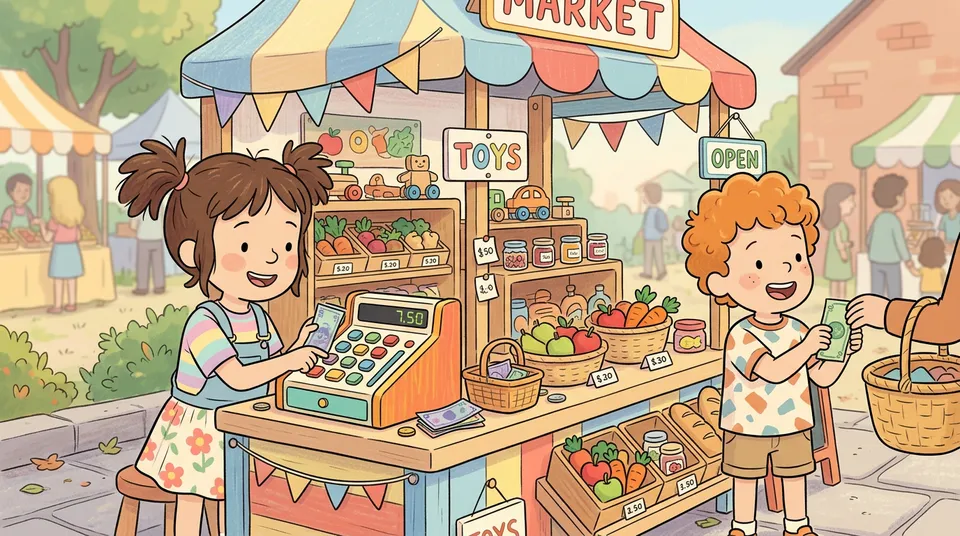
Teaching kids about money doesn’t have to feel like a maths lesson. The best approach? Games. When children play with money concepts, whether digital or hands-on, they absorb skills naturally without even realising they’re learning.
We’ve rounded up the best money games for kids across different formats, so you can find what works for your child’s age and interests.
1. myplayshop — The Realistic Shop Simulator
If your child loves pretend play, myplayshop takes the classic “playing shop” experience and puts it on a tablet. Kids run their own shop, handling real currency denominations, giving correct change, and managing transactions, all without any real money at risk.
What sets it apart from other apps is the realism. Instead of cartoon coins, children work with actual currency designs from multiple countries. They practise mental arithmetic in a context that feels like play, not homework. It supports 8 currencies and 13 languages, making it useful whether you’re in London, Oslo, or Athens.
Best for: Ages 4-10 | Available on iPad
2. The Lemonade Stand — Classic Entrepreneurship
Setting up a real lemonade stand (or any simple selling activity) remains one of the best money games out there. Children learn pricing, making change, and the basic idea that you spend money to make money.
You don’t need a full setup. Even a small table with homemade biscuits or drawings for sale teaches the fundamentals. Let your child set the prices, handle the cash, and count the takings at the end. The maths happens naturally.
Best for: Ages 5-10 | No cost
3. Monopoly Junior — Board Game Budgeting
The junior version of Monopoly simplifies the original while keeping the core money lessons intact. Children practise counting money, making purchases, and understanding that resources are limited.
Unlike the full version, games are shorter and the maths is simpler, which means younger kids actually finish a game without losing interest. It’s a solid choice for family game nights that sneak in financial literacy.
Best for: Ages 5-8 | Board game
4. The Coin Sorting Challenge
This one needs no special equipment, just a pile of real coins. Empty out your change jar and challenge your child to sort coins by value, then count up each pile. For older kids, set challenges: “Can you make exactly 73p using the fewest coins?”
It’s simple, tactile, and surprisingly engaging. Children love handling real money, and the physical act of sorting and counting builds stronger number sense than screen-based drills alone.
Best for: Ages 4-8 | Free with household coins
5. The Grocery Budget Game
Next time you go shopping, give your child a small budget (real or pretend) and a short list. Their job is to find the items and stay within budget. Older children can compare prices and work out which option gives better value.
This is real-world maths in action. Children learn to read price labels, add running totals, and make trade-offs, exactly the skills they’ll need as adults. Start with three or four items and a generous budget, then increase the challenge as they gain confidence.
Best for: Ages 6-10 | Free
6. Pay Day — The Earning and Spending Game
Pay Day is a board game where players move through a month, earning money, paying bills, and dealing with unexpected expenses. It introduces concepts like loans, savings, and budgeting across time, which most kids’ games skip entirely.
The monthly structure helps children understand that money isn’t just about single transactions. Sometimes you need to save for something coming next week, or deal with a surprise cost. These are lessons that stick.
Best for: Ages 6-10 | Board game
7. The Family Shop at Home
Turn your living room into a shop using items from around the house. Price everything with sticky notes, give your child play money (or real coins), and let them buy and sell. Take turns being the shopkeeper and the customer.
This low-tech game is incredibly effective because children set the prices, calculate totals, and make change themselves. Add complexity over time: introduce discounts, “buy one get one free” offers, or a savings jar for bigger purchases. For a more polished version of this concept with real currency practice, try myplayshop on your tablet.
Best for: Ages 4-9 | Free with household items
How to Choose the Right Money Game
Not every game suits every child. Here’s a quick guide:
- Ages 4-5: Start with coin sorting, the family shop, or myplayshop on easy mode. Keep sessions short and focus on recognising coins and simple counting.
- Ages 6-7: Add board games like Monopoly Junior, the grocery budget challenge, and more complex shop play with giving change.
- Ages 8-10: Introduce Pay Day, real lemonade stands, and price comparison challenges. These children are ready for multi-step money problems.
The key is consistency over intensity. Ten minutes of money play three times a week beats an hour-long session once a month. Make it regular, keep it fun, and the financial skills will follow.
Why Games Beat Worksheets for Money Skills
Research consistently shows that children learn mathematical concepts more deeply through play than through repetition-based practice. Money is an especially good fit for game-based learning because it’s inherently practical. Every child has seen adults use money, and they’re motivated to understand it.
Games also remove the fear of getting things wrong. When a child miscounts change in a board game, they simply try again. There’s no red pen, no grade, and no pressure. That low-stakes environment is exactly where genuine learning happens.
Getting Started
Pick one game from this list and try it this week. You don’t need to buy anything — the coin sorting challenge or family shop game costs nothing and takes five minutes to set up. Once your child is engaged, gradually introduce new activities to build on what they’ve learned.
The goal isn’t to create a tiny accountant. It’s to build the kind of everyday number confidence that will serve your child for life.